NotiLens vs Better Uptime vs Cronitor: Which Monitoring Tool Is Right for Your Stack?
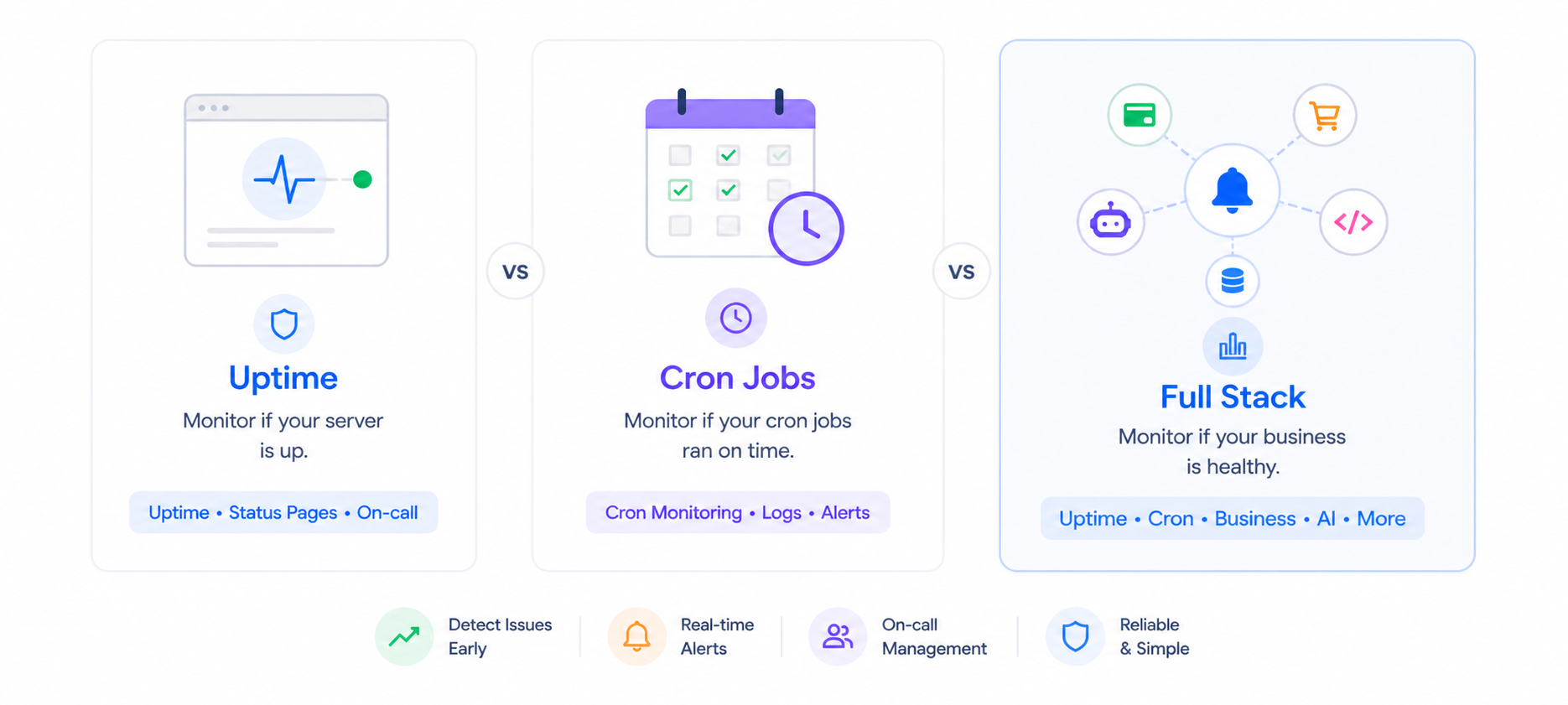
Better Uptime monitors if your server is up. Cronitor monitors if your cron jobs ran. NotiLens monitors whether your business is healthy — payments, orders, agents, jobs, and servers, all in one place with ML-powered silence detection.
If you've been looking for a monitoring tool in 2026, you've probably landed on Better Uptime (now Better Stack) or Cronitor. Both are solid tools. Both are purpose-built — and that's exactly the limitation.
Better Uptime tells you when your server goes down. Cronitor tells you when your cron job didn't run. NotiLens tells you when your business is unhealthy — and that's a meaningfully different scope.
This post breaks down all three tools honestly so you can pick the right one for your stack.
TL;DR
| NotiLens | Better Uptime (Better Stack) | Cronitor | |
|---|---|---|---|
| Built for | Founders, small teams — full business monitoring | DevOps teams — uptime + incident management | Developers — cron job and scheduled task monitoring |
| Starting price | $19/mo flat | Free (10 monitors); paid from $24/mo | Free (5 monitors); paid from $7/mo per monitor |
| Cron job monitoring | ✅ Yes + broken flow detection | ✅ Basic heartbeat | ✅ Best-in-class |
| Uptime monitoring | ✅ Yes | ✅ Best-in-class | ✅ Yes |
| Smart Silence Detection | ✅ ML auto-learns baseline | ❌ Manual window only | ❌ Manual window only |
| Broken flow detection | ✅ Yes — multi-step flow tracking | ❌ No | ❌ No |
| Business monitoring (Stripe, Shopify) | ✅ Yes | ❌ No | ❌ No |
| AI agent monitoring | ✅ Yes (MCP-native) | ❌ No | ❌ No |
| On-call scheduling | ✅ Yes | ✅ Yes (per responder pricing) | ⚠️ Basic |
| Escalation policies | ✅ Yes | ✅ Yes | ⚠️ Via PagerDuty/OpsGenie integration |
| ML anomaly detection | ✅ Yes | ❌ No | ❌ No |
| Status pages | ❌ Not yet | ✅ Yes | ✅ Yes |
| Log management | ❌ No | ✅ Yes (Better Stack) | ❌ No |
| Free trial | ✅ 7 days, no card | ✅ Free tier available | ✅ Free tier available |
What Is Better Uptime (Better Stack)?
Better Uptime started as a website uptime monitor and rebranded to Better Stack in 2023 after expanding into logs, metrics, and observability. The uptime monitoring product remains its core strength.
Better Stack is an eBPF-based, AI SRE observability tool that monitors everything from websites to servers, with on-call scheduling, incident management, and log aggregation.
It's a strong choice if you need uptime monitoring and incident orchestration together, with a modern interface and fast setup.
Where Better Stack excels:
- Multi-location uptime verification (incidents confirmed from 3+ locations before alerting)
- Built-in status pages for customer-facing communication
- Log management and structured querying alongside uptime
- Clean incident timeline with second-by-second breakdown
- On-call scheduling with calendar integration
Where Better Stack falls short:
- Per-responder pricing — $29/month per responder for full on-call features — costs compound fast for small teams
- No awareness of your business layer — payments, orders, AI agents
- No ML baseline learning — silence alerts require manual window configuration
- No broken flow detection
- Free tier limited to 10 monitors with basic features
What Is Cronitor?
Cronitor is a purpose-built cron job and scheduled task monitoring tool. It's been around for years and has one of the best developer experiences for job-level monitoring.
Cronitor monitors cron jobs, pipelines, daemons, and APIs, detecting problems in seconds and sending alerts when a job fails, runs late, or doesn't start on schedule.
If cron job monitoring is your primary need, Cronitor is excellent at exactly that.
Where Cronitor excels:
- Schedule-aware monitoring — understands your cron syntax and expects jobs to run on time
- Grace periods and schedule tolerances to reduce false positives
- Per-run logs and metrics captured automatically
- 12-month data retention for job history
- Kubernetes and CLI auto-discovery to find and monitor jobs without manual setup
- Clean run timelines showing late, missed, long-running, or failed executions
Where Cronitor falls short:
- Pricing recently changed to per-monitor billing ($2/monitor/month) — costly if you have many cron jobs
- Cron-only focus — no Stripe, Shopify, server uptime, or AI agent monitoring in the same tool
- No ML baseline — manual schedule windows required
- No broken flow detection across multi-step processes
- Escalation policies via third-party integrations (PagerDuty, OpsGenie) rather than built-in
What Is NotiLens?
NotiLens is a business monitoring and alerting platform built for founders, developers, and small teams. It watches your entire stack — not just whether your server is up or your cron job ran, but whether your business is healthy.
The key differences from both competitors:
Smart Silence Detection — ML automatically learns your normal activity patterns across all monitored sources. No manual windows to configure. The model adapts as your traffic patterns change.
Broken flow detection — NotiLens tracks multi-step processes (payment.initiated → payment.completed, job.started → job.completed) and alerts when a flow starts but never finishes. Neither Better Stack nor Cronitor has this.
Business layer — Stripe payments, Shopify orders, GitHub activity, AI agents. These aren't infrastructure metrics — they're the events that directly affect your revenue. Neither competitor monitors them.
Pricing Comparison
Pricing is where the three tools diverge significantly for small teams.
Better Stack:
- Free: 10 monitors, 3-minute checks, no team members
- Freelance: $24/month, 50 monitors, 30-second checks, no team members
- Small Team: $64/month, 100 monitors, up to 5 team members
- On-call responders: $29/month per person (separate add-on)
- A team of 3 with on-call: $64 + (3 × $29) = $151/mo
Cronitor:
- Free: 5 monitors, email and Slack alerts, 1-month data retention
- Business: $2/monitor/month + $5/user/month
- 20 monitors, 3 users: (20 × $2) + (3 × $5) = $55/mo
- 50 monitors, 5 users: (50 × $2) + (5 × $5) = $125/mo — costs scale fast
NotiLens:
- Pro: $19/mo — solo founder, unlimited topics, 5,000 events/mo
- Team: $89/mo — up to 10 people, 50,000 events/mo, on-call + escalation
- Flat rate — no per-monitor, no per-responder, no per-seat surprises
For a team of 3 needing cron monitoring + uptime + on-call: Better Stack costs ~$150/mo, Cronitor scales toward $100+/mo depending on monitor count, NotiLens is a flat $89/mo — covering all of those categories plus business events, AI agents, and silence detection.
Feature Deep-Dive
Cron Job Monitoring
Cronitor is the benchmark here. Schedule-aware alerts, grace periods, per-run logs, run timeline visualisation, auto-discovery for Kubernetes jobs — purpose-built and mature.
Better Stack supports heartbeat monitoring for cron jobs — you send a ping, it alerts if the ping stops. Functional but not as feature-rich as Cronitor for complex scheduled task environments.
NotiLens covers cron job monitoring via the SDK task lifecycle (run.start() → run.complete()) with Smart Silence Detection and broken flow detection. It won't match Cronitor's run timeline visualisation or schedule syntax parsing — but it catches the failures that matter most (job didn't start, job started but never finished, job completed with anomalous metrics) with less manual configuration.
Verdict: If cron monitoring is your only need and you have many jobs, Cronitor is purpose-built. If cron monitoring is one of several things you need, NotiLens covers it alongside everything else.
Uptime Monitoring
Better Stack is the strongest here — multi-location verification, 30-second check intervals, incident timelines, status pages, and SSL monitoring. A mature, well-designed uptime tool.
Cronitor also offers uptime monitoring as a secondary feature alongside cron monitoring. Functional but not its primary strength.
NotiLens includes uptime monitoring — server availability, SSL expiry, API health checks. Not as feature-rich as Better Stack's multi-location verification and status pages, but covers the alerts that matter for small teams.
Verdict: If uptime monitoring with status pages and multi-location verification is your primary need, Better Stack wins. For most small teams who need uptime as part of broader business monitoring, NotiLens is sufficient.
On-Call Scheduling
Better Stack has solid on-call features — calendar integration, rotation management, escalation policies. The catch is per-responder pricing ($29/mo per person).
Cronitor offers basic alerting routing but relies on PagerDuty or OpsGenie integrations for proper on-call scheduling — adding cost and complexity.
NotiLens includes full on-call scheduling in the Team plan ($89/mo flat): weekly/daily/custom rotations, timezone-aware active hours, holiday overrides, escalation policies with configurable delays, and Do Not Disturb per user. No per-responder fees.
Verdict: NotiLens has the best value for small teams needing on-call. Better Stack is stronger for complex enterprise escalation workflows but costs significantly more.
What Nobody Else Has
Three capabilities in NotiLens that neither Better Stack nor Cronitor offers:
1. Smart Silence Detection Both competitors require you to define a manual window ("alert if no ping in 2 hours"). NotiLens's ML learns your normal activity pattern automatically — for payment flows, signup rates, API traffic, and job schedules — and alerts when things go abnormally quiet without manual threshold setting.
2. Broken Flow Detection
If job.started fires but job.completed never comes — within the ML-learned expected window — NotiLens alerts. This catches partial failures that heartbeat monitoring misses: jobs that start but crash halfway, payments that initiate but never complete.
3. Business Layer Monitoring Stripe payment failures, Shopify order gaps, AI agent loops, GitHub deployment events — none of these exist in Better Stack or Cronitor. NotiLens is the only tool in this comparison that watches your revenue layer alongside your infrastructure.
Who Should Use What
Use Better Stack if:
- Uptime monitoring with status pages is your primary need
- You need log management integrated with uptime in one platform
- You have a dedicated DevOps team comfortable with per-responder pricing
- Multi-location incident verification matters to you
- You're already using their log ingestion and want to consolidate
Use Cronitor if:
- Cron job monitoring is your primary or only need
- You have complex scheduled task environments (Kubernetes, multiple environments)
- You need rich per-run logs, dashboards, and schedule visualisation
- You're comfortable with per-monitor pricing and have a manageable number of jobs
Use NotiLens if:
- You're a founder or small team who needs to monitor your business — not just your servers
- You want silence detection that learns your baseline automatically — no manual windows
- You need to monitor Stripe, Shopify, AI agents, or any custom business event
- You want cron monitoring, uptime, on-call, and business alerts in one flat-rate tool
- You're tired of running three separate monitoring tools and paying three separate bills
The "Three Tools" Problem
Many small teams end up with:
- Better Stack for uptime
- Cronitor for cron jobs
- Something else for Stripe/business alerts
That's three dashboards, three monthly bills, three alert channels to maintain, and three different places to look when something breaks at 3am.
NotiLens is designed to replace that setup with a single tool. Not because it's better than each specialist tool in its own domain — Cronitor's cron dashboard is genuinely excellent — but because for most small teams, the overhead of running three tools costs more than the marginal feature depth they provide.
One alert at 3am that routes correctly to the right on-call engineer and escalates if unacknowledged is worth more than three specialist dashboards you switch between.
For a practical week-by-week setup guide that replaces all three tools, see The Founder's Monitoring Stack
Summary
Better Stack is the best pure uptime + incident management tool for teams that need that combination and are comfortable with per-responder pricing.
Cronitor is the best pure cron job monitoring tool for teams with complex scheduled task environments.
NotiLens is the right choice if you need your monitoring to cover your whole business — infrastructure, jobs, payments, orders, and agents — in a single flat-rate tool, with ML-powered silence detection and broken flow detection that neither competitor has.
Try NotiLens free for 7 days — no credit card required.
Frequently Asked Questions
Can I use NotiLens alongside Cronitor or Better Stack? Yes. Some teams use Cronitor for its schedule-aware cron dashboard and NotiLens for business event monitoring and on-call routing. Others use Better Stack's log management and NotiLens for silence detection and business alerts. The tools are complementary if you need the specialist depth.
Does NotiLens have a status page feature? Not yet — status pages are on the roadmap. If a customer-facing status page is a hard requirement today, Better Stack or Cronitor are better options for that specific feature.
Is Cronitor's per-monitor pricing expensive for many jobs? It can add up. At $2/monitor/month, 50 cron jobs costs $100/month before adding users ($5/user/month). For teams with a large number of jobs, NotiLens's unlimited topics at a flat rate is significantly more cost-effective.
How does NotiLens's cron monitoring compare to Cronitor's schedule parsing? Cronitor understands your cron syntax natively and knows when a job should have run based on the schedule expression. NotiLens uses Smart Silence Detection to learn when your job normally completes — it doesn't parse cron syntax directly. For jobs with strict schedule requirements, Cronitor's schedule-awareness catches "ran 5 minutes late" more precisely. For everything else, NotiLens's ML approach catches the failures that matter without manual configuration.
What happens if I need both uptime and cron monitoring? NotiLens covers both in a single $19/mo Pro plan — uptime checks for your server endpoints and SDK-based task monitoring for your cron jobs. You don't need two separate tools or two separate bills.